Where the Easel Used to Stand: Checking In to Britain's Former Art Schools
You can often tell a former art school before you see the sign. The windows are too tall for a house, the ceilings too high, the floors scuffed in a way that suggests decades of easels and not a single mop. These are buildings that were designed for looking — and now, increasingly, they are places to stay. Across the UK, former art schools and technical colleges are being reimagined as B&Bs, and the result is a different kind of art break: one where the architecture itself does some of the teaching.
The Architecture of Attention
Art schools are not grand. They are practical, a bit battered, and full of north light. That north-facing glass was no accident: it gave students a steady, unglamorous light that didn’t shift with the sun. Stay in one and you inherit that light. Morning coffee comes with a long, cool wash of it across the floor. You find yourself looking at things for longer — the grain of a table, the shadow of a railing — because the room seems to expect it.
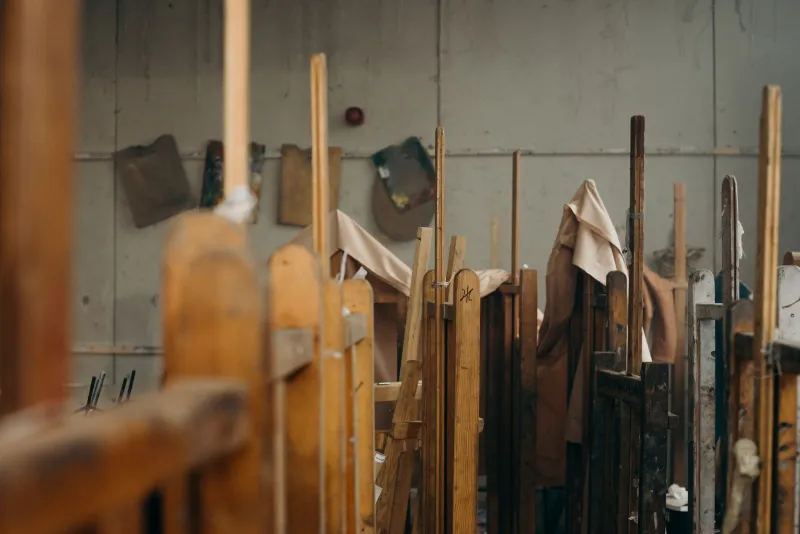
Many of these buildings also retain their old studio layouts: wide corridors, heavy doors, sinks in odd corners. Some B&Bs leave the traces deliberately — a plaster cast on a shelf, a life-drawing easel in the corner of a guest room, a noticeboard still pinning up a timetable from 1978. It could be kitsch. Mostly, it isn’t. The best conversions let the building speak quietly rather than shout.
Life Rooms and Plaster Casts
The life-drawing room is the heart of the old art school, and several B&Bs have kept theirs as communal spaces. You might find a stack of drawing boards, a skeleton model, or a dusty collection of plaster casts — hands, feet, a flayed torso — that once taught anatomy to generations of students. These aren’t museum pieces; they’re part of the furniture. And that’s the point. You don’t have to draw to feel the room’s purpose. You just have to sit in it.
Pair that with a nearby gallery and the lesson doubles. A morning spent in a former life room, followed by an afternoon in a civic collection, makes you notice how much of art is about attention. The old school teaches you to look at the building; the gallery teaches you to look at the work. Together, they slow you down.
Three Former Art Schools to Book
The Old Art School, Kirkcudbright This small town in Dumfries & Galloway has been an artists’ colony since the 1880s, and its former art school is now a characterful B&B with studio-sized rooms and a garden that catches the afternoon light. Pair it with Kirkcudbright Galleries, which holds a strong collection of Scottish colourists and a rolling programme of contemporary shows. Check the gallery’s 2026 dates before you book — the town’s artistic calendar is busy, and the B&B fills up around exhibitions.
Art School House, Bristol Bristol’s art scene is loud and scruffy in the best way, and this former art school building in the city has been converted into a B&B with high ceilings, original parquet, and a communal kitchen that feels like a student union in the best possible sense. Walk to Arnolfini for contemporary exhibitions, or head to Spike Island for a dose of studio-led practice. The city’s street art is a permanent exhibition in itself; the B&B can point you towards the quieter pieces.
The Old Technical College, St Ives St Ives has been synonymous with art for over a century, and this former technical college — now a small B&B — retains its north-facing studios and a beautiful, slightly worn assembly hall. The light is the main event. Pair your stay with Tate St Ives and the Barbara Hepworth Museum and Sculpture Garden, both a short walk away. The gallery’s 2026 programme is worth timing your trip around; even without a blockbuster, the permanent collection rewards a slow morning.
The Critique
Why do these places work? Not because they’re nostalgic, but because they’re honest. An art school is a building that was designed for practice, not for display. When you stay in one, you’re not a spectator; you’re in the room where the work happened. That changes your relationship with the art you see afterwards. You notice the effort. You notice the mistakes. You notice the light.
And that’s the real lesson in looking: it’s not about standing in front of a masterpiece and feeling something. It’s about paying attention to the ordinary — a windowsill, a plaster cast, a scuffed floor — and letting it teach you. Britain’s former art schools are full of ordinary things. That’s why they’re worth checking into.